
Since 2022, the world’s largest technology companies have committed themselves to an unprecedented build-out of AI infrastructure. Combined spending could approach $1.1 trillion by 2027, reshaping not only the technology sector but also credit markets, utilities and corporate funding strategies. The question for investors is not whether AI is transformative, but whether the economics ultimately justify the scale of investment. That is the question we explore here and why our view remains constructive, though selective.
What the money buys
At its core, an AI data centre is a very large, power hungry machine. The hyperscalers, large cloud-computing companies such as Microsoft, Amazon and Google, are investing in four main layers: buildings, power, cooling and networking, and compute. Power is increasingly the binding constraint, with grid queues running up to seven years and data centres potentially accounting for 9–17% of US electricity demand by 2030. GPUs are also being supplemented by custom chips such as Google’s TPU, Amazon’s Trainium and Microsoft’s Maia. The final bottleneck is high-bandwidth memory, supplied by only three companies, with both Meta and Microsoft citing memory costs as a driver of higher capex guidance.
A dense web of cross-holdings
Each hyperscaler has also become a direct backer of some of its biggest AI-lab customers. Publicly reported commitments and stakes include Amazon’s investments in Anthropic and OpenAI; Microsoft’s stake in OpenAI, alongside a large Azure commitment from OpenAI; Alphabet’s commitment to Anthropic; Meta’s stake in Scale AI; and Oracle’s role in Stargate. These links matter because capex, funding and earnings quality increasingly interact across the AI ecosystem.
Bottlenecks and financing
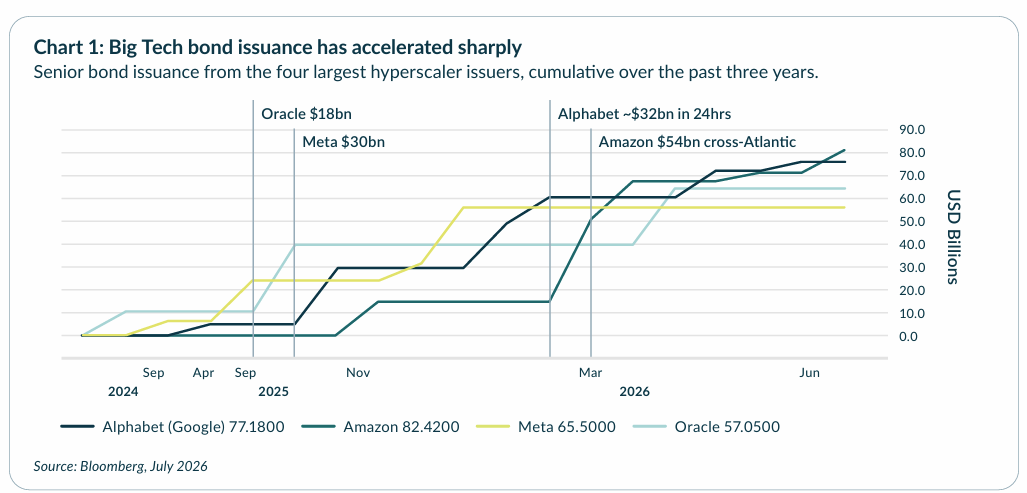
Demand has outrun supply, lifting costs at Oracle and Microsoft alike. Power is the more structural constraint; chip and memory scarcity have been more cyclical, though both currently bind. Funding differs sharply: Microsoft has funded its build-out almost entirely from cash flow, with no bond deal in five years. Alphabet and Amazon have pre-funded aggressively, including euro tranches, while Meta has pushed spending off-balance-sheet via a joint venture with Blue Owl. Oracle has funded most of its programme externally through bonds convertible preferred stock, equity, and one asset sale.
Read the full article on our website
Disclaimer
This document of Van Lanschot Kempen Investment Management N.V. (VLK Investment Management) is for information purposes only and provides insufficient information for an investment decision. This document does not contain investment advice, no investment recommendation, no research, or an invitation to buy or sell any financial instruments, and should not be interpreted as such.
The views expressed in this document may be subject to change at any given time, without prior notice. VLK Investment Management has no obligation to update the contents of this document.
As asset manager, VLK Investment Management may have investments, generally for the benefit of third parties, in financial instruments mentioned in this document and it may at any time decide to execute buy or sell transactions in these financial instruments.
This document is based on information that we consider reliable, but we do not represent that it is accurate or complete, and it should not be relied on as such. The value of investments may fluctuate. Past performance is no guarantee of future results.
This document has been produced independently of the companies mentioned and the views contained herein are entirely those of VLK Investment Management.
Investing in euro credit involves risks, including interest rate risk, credit risk (including downgrade and default risk), liquidity risk and general market risk. The value of investments may fluctuate and investors may not get back the amount originally invested.
Past performance is no guarantee of future results. The value of investments may fluctuate and investors may not get back the amount originally invested.