
Engagement and voting are key tools in our stewardship and active ownership approach. Together, they allow us to use our voice and influence to encourage progress on ESG matters. As we enter the third quarter of 2026, we take stock of our activities in this area during the first six months of the year.
Voting in practice
Most shareholder meetings take place in May, June and July, making this the heart of the voting season. For us, voting at shareholder meetings of investee companies is a key tool in stewardship and active ownership. It also gives us an opportunity to reinforce the points we have raised through our engagement activities during the year.
We vote based on our voting policy, which stipulates our expectations on matters including good governance, such as board diversity and meaningfully structured remuneration. We vote for our discretionary assets in our credit and equities funds, our Mercier Van Lanschot funds and Van Lanschot Kempen Mandate Fund World Equity.
In the first half of 2026:
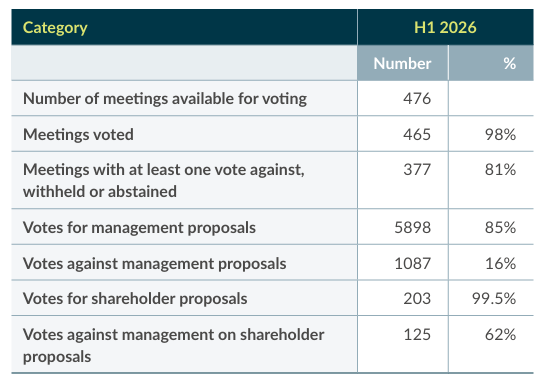
- We voted at 465 shareholder meetings. At 377 of these meetings, we voted against, withheld or abstained on at least one agenda item. We tend to abstain to give a company’s management time to resolve an issue, on the understanding that we will vote against management in future if no changes are implemented.
- We also voted on 203 shareholder proposals. In 125 cases, we voted against management. Of these shareholder proposals, 30 were related to climate or environmental issues, 54 to social issues such as human rights, and 119 to governance matters.
Voting at ‘Big Oil’
Large oil and gas companies tend to attract attention during voting season. We highlight two meetings from this season.
Shell: the future earnings model
At Shell’s annual general meeting, we voted in favour of a resolution filed by shareholder collective Follow This. The resolution asked Shell to provide greater transparency on how the company intends to remain profitable as demand for oil and gas declines. We believe such disclosure would help shareholders better assess Shell’s climaterelated risks, including with regard to capital expenditure, production planning and dividend payments.
This was the first time Follow This had submitted a resolution from this particular angle. In previous years (the collective has been active at shareholder meetings of large oil and gas companies since 2016) it mainly asked oil and gas companies to align their emissions with the Paris Agreement. This year, the focus shifted to a question that is always relevant for shareholders: the future earnings model.
BP: controversy around the chair
Follow This also sought to put the same resolution to a vote at BP’s shareholder meeting. This caused controversy, however, because BP refused to include the resolution on the agenda.
Follow This subsequently called on shareholders to vote against the reappointment of chair Albert Manifold and received support from several larger shareholders.
We did not vote against his reappointment, mainly because we did not want to reignite earlier unrest at BP, where both the chair and the CEO had recently been replaced. Manifold ultimately remained in post after the shareholder meeting, although his reappointment was approved by a much smaller margin than is customary in this type of vote. Shortly afterwards, he nevertheless stepped down following criticism of his leadership style.
Manifold also came under fire at the shareholder meeting over two management resolutions: one to substantially scale back BP’s current climate reporting and another to hold shareholder meetings online only in future. Like the majority of shareholders, we voted against both resolutions. As a result, the existing arrangements remain unchanged for the time being.
Engagements to raise awareness and drive change
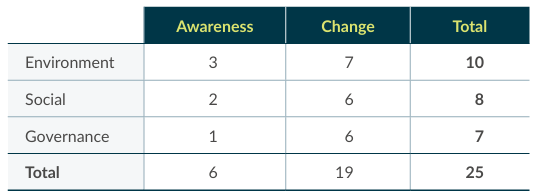
In the first months of 2026, we engaged directly with 25 companies on environmental, social and governance themes. These engagements were carried out by members of the teams managing our liquid credit and equities strategies and/or by our ESG Advisory team. Ten engagements focused on environmental issues, eight on social issues and seven on governance matters.
Engagements for change and awareness per theme January- June 2026
Some examples of our engagements
Attention from the chair – Diös Fastigheter (governance)
In 2025, we engaged with Swedish real estate company Diös Fastigheter to further strengthen governance quality. We raised concern that, in our view, the workload of the chair of the supervisory board was too high and that he needed more time to fulfil his role by reducing external commitments. We also advocated a remuneration structure that better balances the interests of management and shareholders with company performance and sustainability. In addition, we discussed the long tenure of the same auditor.
Our dialogue with the company was constructive and led to tangible results: the chair stepped down from one board position, the auditor will rotate from 2026, and Diös introduced new remuneration plans with both financial and ESG objectives. We therefore successfully closed this engagement in the first half of 2026.
Learning from a frontrunner – Catena (biodiversity)
We engaged with Catena, another Swedish logistics real estate company, on integrating biodiversity into property development and management. In 2026, we visited the company. Biodiversity is a material topic for logistics real estate, given the large amount of land occupied by assets such as warehouses and the impact of new developments on ecosystems. With Catena, we discussed objectives, measurement methods and reporting, among other topics.
Our engagement with Catena also gave us, as an investor, the opportunity to learn from a company at the forefront of this area. Catena aims to achieve a net positive impact on biodiversity by 2030 and applies a structured methodology to assess the impact of new projects and, increasingly, existing assets as well. These insights help us further deepen our assessment of biodiversity related opportunities and risks. We remain in contact with Catena and will continue to monitor its progress.
Opportunities and risks – General Mills (climate and nature)
As part of the Dutch Engagement Coalition, a collaboration of Dutch investors supporting the Climate Agreement, we engaged with US food company General Mills alongside other coalition members. Van Lanschot Kempen acted as one of the co-leads. The aim of the engagement was to better understand how the company is preparing for climate and nature related risks and opportunities. Among other topics, we discussed biodiversity, deforestation, regenerative agriculture and responsible water use.
The engagement began in November 2025 with a formal letter, followed by an extensive questionnaire and a written response from General Mills. A follow up meeting took place in May 2026. During the dialogue, the company demonstrated an understanding of key climate and nature related dependencies, particularly water, and pointed to several ongoing initiatives and partnerships. At the same time, we encouraged the company to demonstrate more clearly the measurable outcomes of these efforts, their financial materiality and how they are incorporated into strategic decision making. This engagement will continue.
Disclaimer
Van Lanschot Kempen Investment Management (VLK IM) is licensed as a manager of various UCITS and AIFs and authorised to provide investment services, and as such is subject to supervision by the Netherlands Authority for the Financial Markets.
This document is for information purposes only and provides insufficient information for an investment decision. This document contains no investment advice, no investment recommendation, no research, nor any invitation to buy or sell any financial instruments, and should not be interpreted as doing so. The opinions expressed in this document are our opinions and views as of the date of writing only. These may be subject to change at any given time, without prior notice.
As an asset manager, VLK IM may have investments, generally for the benefit of third parties, in financial instruments mentioned in this document and it may at any time decide to execute buy or sell transactions in these financial instruments.
Capital at risk
The value of investments and the income from them can fall as well as rise and are not guaranteed. Investors may not get back the amount originally invested. Past performance provides no guarantee for the future. The information contained within this publication is
provided for general and reference purposes only. Under no circumstances may the information contained within this publication be construed as an offer, nor may any rights be derived therefrom.
In preparing this publication, we have exercised the greatest possible care in the selection of external sources. We provide no guarantees whatsoever that the information provided by these sources and contained within this publication is correct, accurate, and complete, nor that it will remain so in the future. We accept no liability whatsoever for any misprints or typesetting errors. We are under no obligation whatsoever to update or modify the information we have included in this publication. All rights with respect to the contents of this publication are reserved, including the right of modification.