
A standard MSCI index provides less comprehensive market exposure than many investors think. By focusing on large- and mid-cap companies, it overlooks hundreds of businesses labelled “small cap”, a relative term. Many ‘small caps’ are sizeable companies and leaders in specialist markets; their combined revenues have grown relative to those of large-cap companies. Investors who ignore them risk missing a broad and increasingly important part of the market.
Several widely followed indices track the performance of different, often individual equity markets, including the S&P 500, EURO STOXX 50, FTSE 100, DAX and AEX. However, the industry’s most commonly used benchmarks are the indices provided by MSCI.
Many investors assume that investing in a standard MSCI country index provides comprehensive exposure to that country’s equity market. However, MSCI’s methodology shows that this is only partially true. A standard MSCI country index comprises the large- and mid-cap segments and is designed to capture approximately 85% of the country’s free-float-adjusted market capitalisation.
The next 14% constitutes the small-cap universe, which falls outside the MSCI standard index. Because market structures and companysizes vary by country, the market-capitalisation thresholds that determine whether a company is classified as large-, mid- or small-cap also differ across countries. A standard MSCI regional index combines the relevant country indices, so the definition of small cap varies across regions as well.
Size, significance and opportunity
For investors, there are three key takeaways:
First, US small-cap companies are generally larger than their European counterparts. At the end of August 2026, the largest constituent of the MSCI USA Small Cap Index had a market capitalisation of around USD 30 billion, excluding Moderna (Moderna’s marketcapitalisation was exceptionally high relative to the other constituents, making it an outlier). By comparison, the largest constituent of the MSCI Germany Small Cap Index was EUR 9.7 billion.
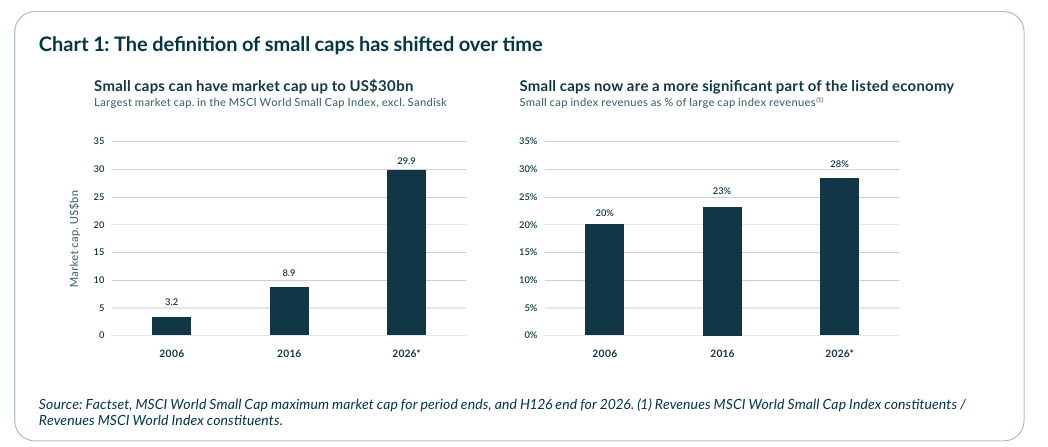
Second, small-cap companies have grown in both size and economic significance. Twenty years ago, the largest company in the MSCI World Small Cap Index had a market capitalisation of around US$3 billion. Today, the largest constituent is closer to US$30 billion. Perhaps more importantly, small caps’ growing importance can be seen in their contribution to overall listed market revenues. In 2006, the aggregate revenues of companies in the MSCI World Small Cap Index were equivalent to 20% of those generated by companies in theMSCI World Large Cap Index. By 2026, this proportion had risen to approximately 28%.
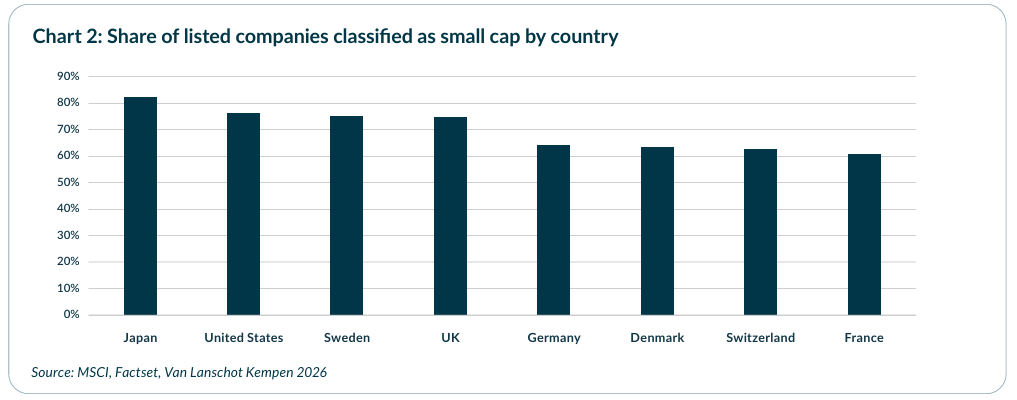
Third, a significant number of listed companies fall outside the standard MSCI Indices. While these businesses may collectively represent a relatively modest share of total market capitalisation, they account for a substantial proportion of each country’s listed corporate landscape. Many are niche leaders in specialised industrial and technology markets that are underrepresented in the large-cap segment. As shown in the chart below, small-cap companies account for around 75% of listed companies in the United States and over 60% in Germany.
A broader opportunity
These three observations show that investors who restrict themselves to standard MSCI indices may miss out on a large and increasingly important segment of the equity market. Small-cap companies are not only more numerous than their name might suggest, but also larger, more economically significant and more diverse in their business models. Broadening the investment universe to include small caps can therefore provide access to a wider range of companies, industries and sources of growth. It’s an opportunity set that is simply too big to ignore.
Discover the opportunity in small caps
From AI-driven growth to attractive valuations and diversification benefits.
Read the key insights in our whitepaper “Better Bet on Small Caps.”
Disclaimer
Van Lanschot Kempen Investment Management (VLK IM) is licensed as a manager of various UCITS and AIFs and authorised to provide investment services and as such is subject to supervision by the Netherlands Authority for the Financial Markets.
This document is for information purposes only and provides insufficient information for an investment decision.
As asset manager VLK IM may have investments, generally for the benefit of third parties, in financial instruments mentioned in this document and it may at any time decide to execute buy or sell transactions in these financial instruments. This document has been produced independently of the companies mentioned, and the views contained herein are entirely those of VLK Investment Management.
This document does not contain investment advice, no investment recommendation, no research, or an invitation to buy or sell any financial instruments, and should not be interpreted as such. The opinions expressed in this document are our opinions and views as of such date only. These may be subject to change at any given time, without prior notice.
General risks to take into account when investing in small-cap strategies
Please note that all investments are subject to market fluctuations. Investing in a small-cap strategy may be subject to country risk, equity market risks and small cap company risk, which could negatively affect the performance. Under unusual market conditions the specific risks can increase significantly.
Potential Investors should be aware that changes in the actual and perceived fundamentals of a company may result in changes for the market value of the shares of such company. Equities of companies with small capitalization can be more volatile than equities of mid and large companies and may also be less liquid.
Capital at risk
The value of investments and the income from them can fall as well as rise and are not guaranteed. Investors may not get back the amount originally invested. Past performance does not predict future returns.
© Van Lanschot Kempen Investment Management 2026